

Share with others:

Innovation from a 15-year-old who uses artificial intelligence to save aquatic ecosystems
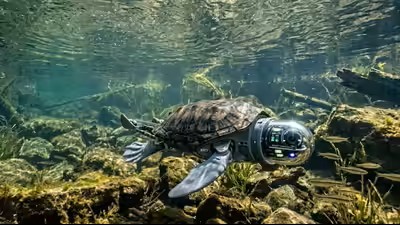
Technology and environmental awareness have come together in an extraordinary project by 15-year-old Canadian student Evan Budz from Dundas, Ontario. The young inventor has developed a bionic underwater robotic turtle called BURT, which is revolutionizing the conservation of marine and freshwater ecosystems. He was inspired by a camping trip on the Great Lakes, where he observed the smooth and efficient movements of loggerhead turtles.
Unlike traditional heavy underwater vehicles and drones, which use noisy propellers and can damage or scare aquatic life, BURT uses soft fin technology. This allows it to move through the water completely silently and gently. This design allows it to explore sensitive areas such as coral reefs without disturbing local creatures or causing damage to the environment.
The key advantage of the BURT robot lies in its advanced software and hardware. It is equipped with high-quality cameras and advanced sensors, and a machine learning model is directly integrated into it. The artificial intelligence is trained to identify serious ecological risks, including plastic waste, coral bleaching and invasive species. According to the CBC, the system works with an astonishing 96% accuracy. When the device is sailing independently, it sends researchers vital data about threats below the surface. This allows scientists and conservationists to take rapid action against the consequences of climate change and human activities.
Evan Budz has proven that important scientific work does not require millions. He built his prototype from affordable, publicly available components and materials. In doing so, he opened the door for the general public to actively participate in protecting the planet. His success quickly resonated internationally. As a representative of Canada, he participated in the European Union Competition for Young Scientists (EUCYS), where he received a great recognition for practical application in environmental science and engineering among hundreds of global competitors. In the future, the young inventor plans to upgrade the robot with additional functions for greater autonomy and more extensive data collection.