

Share with others:

Samsung Galaxy Watch9 review: still haven't gotten rid of the power glitch

There are upgrades, but they are still overshadowed by the very poor battery, which barely lasts a whole day with more than moderate use. Considering that they used a completely new chip, the Snapdragon Wear Elite instead of their own Exynos, and also increased the battery capacity by a few percent, I expected at least a minor upgrade, for example, up to 4 days, but apparently Wear OS is too much of a consumer. Every smartwatch equipped with Wear OS has the same battery problems. I really don't know why Samsung (and others) cling to this system. I understand that it's Google's and because of that you have access to their ecosystem and, for example, contactless payment, which was the core of Huawei watches for many years (until they made the switch to Curve Pay). But after 9 generations of the same comments, maybe Samsung could also start thinking about its own system. They have the resources, the experience as well, so why not?
Let's first take a look at what they've changed before deciding who I can recommend a smartwatch to, which can last maybe two days with modest use.
| Advantages | Weaknesses |
|---|---|
| Accurate dual-frequency GPS | Weak battery life (~1 day) |
| Consistent step counting, even with steady hands | Inconsistent perception of nighttime awakenings |
| A rich set of health sensors | ECG and blood pressure only with a Samsung phone |
| Bright display with sapphire glass | Almost no changes in appearance from Watch8 |
| Easy strap replacement | Proprietary charger and strap |
| 5 years of updates | High price |
Samsung Galaxy Watch9 price and specifications
- Samsung Galaxy Watch9 40mm Bluetooth: 409 €
- Samsung Galaxy Watch9 44mm Bluetooth: 439 € (my test version)
- Samsung Galaxy Watch9 40mm LTE: 459 €
- Samsung Galaxy Watch9 44mm LTE: 489 €
| Sizes | 40mm and 44mm |
| Screen | 1.34″ / 1.47″ AMOLED, sapphire glass |
| Chip | Snapdragon Wear Elite (SW6100), 3 nm |
| Memory | 2GB RAM, 32GB storage |
| Battery | 390mAh (40mm) / 445mAh (44mm) |
| Housing | Armor Aluminum 2, IP68, 5ATM (up to 50 m) |
| GPS | Dual frequency (L1 + L5) |
| Connectivity | Bluetooth 6.0, Wi-Fi, LTE (select models) |
| Sensors | BioActive (HR/ECG/BIA), temperature, gyroscope, barometer, geomagnetic, light |
| Software | One UI Watch 9 (Wear OS 7), Gemini AI |
Samsung Galaxy Watch9: rounded, fairly elegant and identical to last year's Watch8
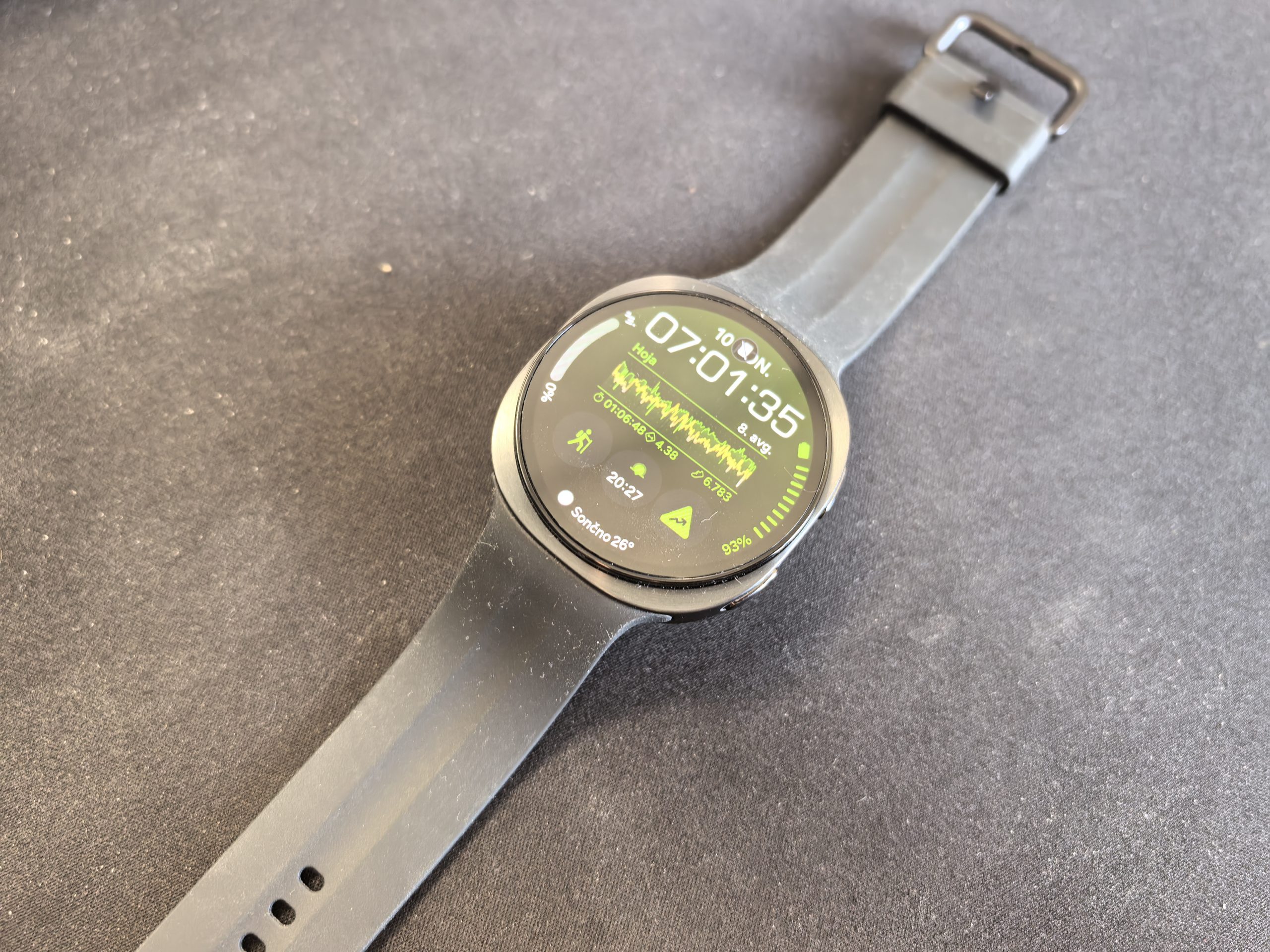
Just as the Galaxy Z Flip8 copied the design, so did the new Galaxy Watch9 smartwatch. There are no noticeable changes to the case. It is still rounded, with clean lines, but not too bold. Such that it can basically fit many styles, both male and female. Hence the two sizes. The 40-mm is clearly more oriented towards female users, and the 44-mm is for men. I also tested the latter, in the black version. The choice affects not only the size, but also the battery capacity. The larger one has 445 mAh (10 mAh more than the Watch8), and the smaller one 390 mAh (65 mAh more than the Watch8).
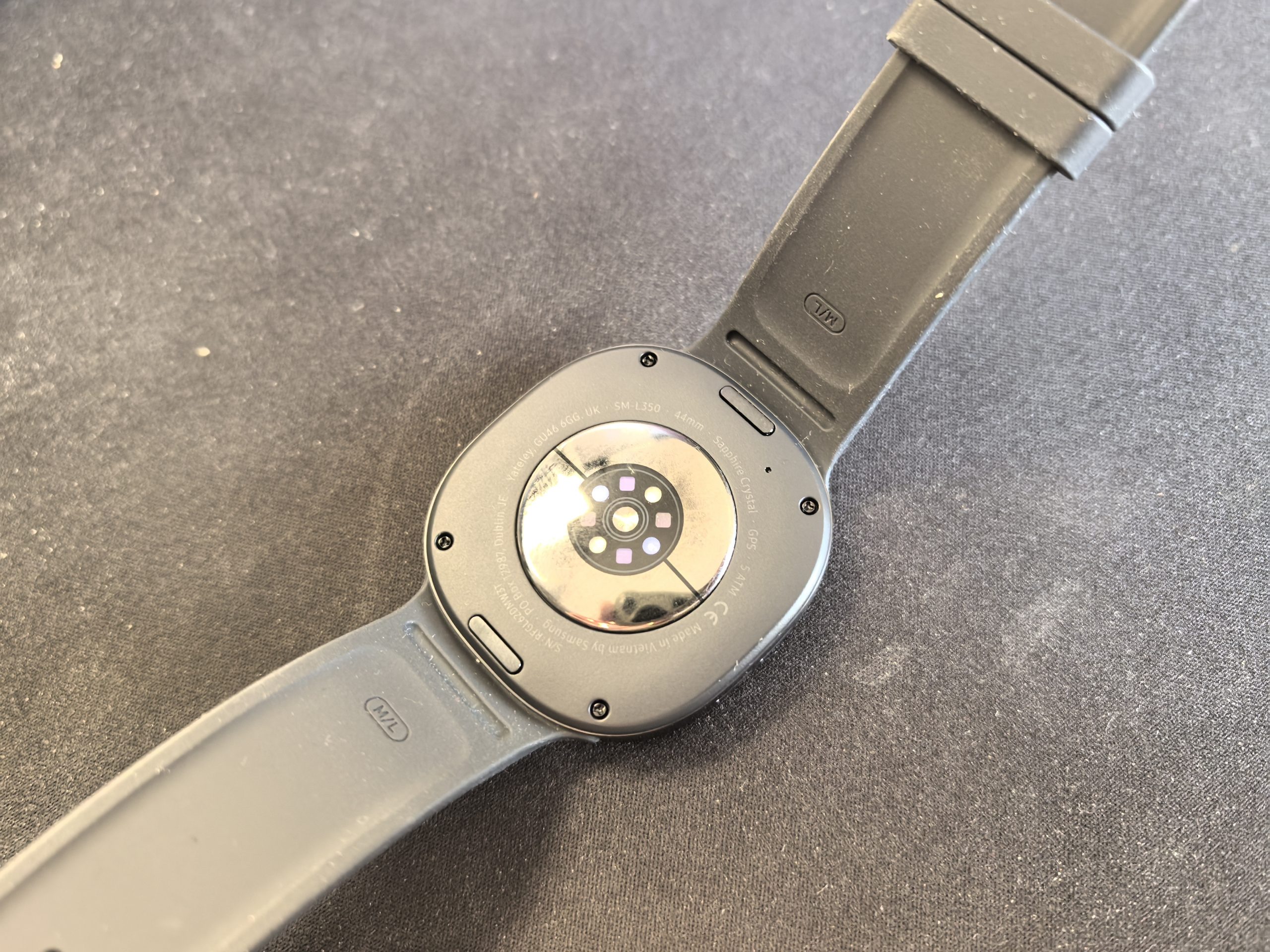
I won't dwell too long on the design, because there really aren't any changes. The new watch is 2 grams heavier, due to the larger battery, the colors have remained the same, and the selection of straps has as well. IP68 protection has remained the same and is still excellent. You can also dive with the watch (up to 50 meters), wear it while showering (although I don't recommend keeping it under hot water for too long), in the pool, and the like. The case is made of aluminum (Armor Aluminum 2), and the bottom side, where the sensors are located, is plastic. Given the price, you could opt for glass or ceramic, like other manufacturers, but I don't think this modest material affects the measurements anyway. The screen is protected by sapphire glass, which from my experience prevents scratches very well, especially micro-scratches.
You can change the straps and changing them is very easy (you click on the pin). When buying, just make sure that you buy a strap that supports Dynamic Lug locking, for example such a strap. You only get one strap in the package by default. Mine was silicone. I think it's also available in fabric and of course in different colors.
The display remains the same, a 1.47-inch (or 1.34-inch for the 40mm version) AMOLED display, protected by the aforementioned sapphire crystal. Brightness is still at the level you'd expect from such a watch. The display is easily readable even in direct sunlight, which I tested on several walks during the summer heat. The Always On Display works smoothly and there are no major differences compared to last generation, which is not surprising, since it's the same panel.
Faster on paper, barely noticeable in practice
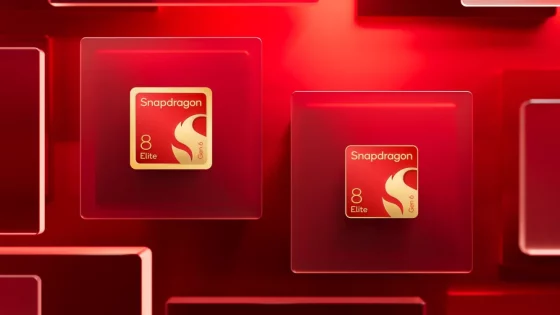
The biggest news of this generation is definitely the change in the chip. For the first time in the history of the Galaxy Watch series, Samsung has abandoned its own Exynos and resorted to Qualcomm's Snapdragon Wear Elite, manufactured using a 3-nanometer process. The same chip also powers the more expensive Watch Ultra2, which I think is a nice move. The cheaper model gets the same processing power as the top-end model.
Samsung promises up to 32-% jump in processor performance and 19-% in graphics, GPS is said to be more accurate even deep in the forest thanks to the new modem. In practice, the watch is definitely responsive, animations run smoothly, applications open without lag, but the same can be said for last year's Watch8. I didn't notice a noticeable difference in everyday use, which is not surprising, considering that it is basically a watch, not a phone, where the additional power would really come into its own. There is still 32 GB of memory and 2 GB of RAM. There is enough space to load a decent music library directly onto the watch. Super convenient if you run a lot, cycle or generally do sports without a phone.
It runs One UI Watch 9, based on Wear OS 7. The Samsung Health app on the phone has been completely overhauled. Each category (sleep, heart, activity, etc.) gets its own tab, and the home page is customizable with smaller and larger widgets. Gemini is natively built in and works via the raise-to-speak feature, which is quite convenient, although the responses themselves are no smarter than on any other Wear OS watch with Gemini. Samsung promises five years of updates, which is decent for a smartwatch.
GPS and step counting: Watch9 pleasantly surprised me
The Watch9 has dual-frequency GPS (L1 + L5), the same as the Watch Ultra2, which is noticeable when recording routes. On walks and short hikes, the routes were practically without deviations. The only thing I noticed several times was the occasional sticking of the route to the nearest building in the city, which is more of a cosmetic flaw than a real problem with accuracy.
I was more surprised by the step count. Samsung itself advises that steps are not counted correctly when the hands are stationary (for example, when pushing a lawnmower or a stroller), as the algorithm primarily looks at the movement of the wrist. In my case, I do most of my walks with a small child by pushing a stroller, and I often walk with hiking poles, where my hands are also in a fairly fixed position, but the watch still recorded a real number of steps relatively consistently, comparable to a phone in my pocket. It's not perfect accuracy, but the deviations were smaller than I would have expected based on the manufacturer's official warnings. This is one of the few things where the Watch9 exceeded my expectations. It's not the only watch that can do this, but a few generations ago (for example, with the Huawei Watch 4 Pro), this type of tracking was difficult and inaccurate.
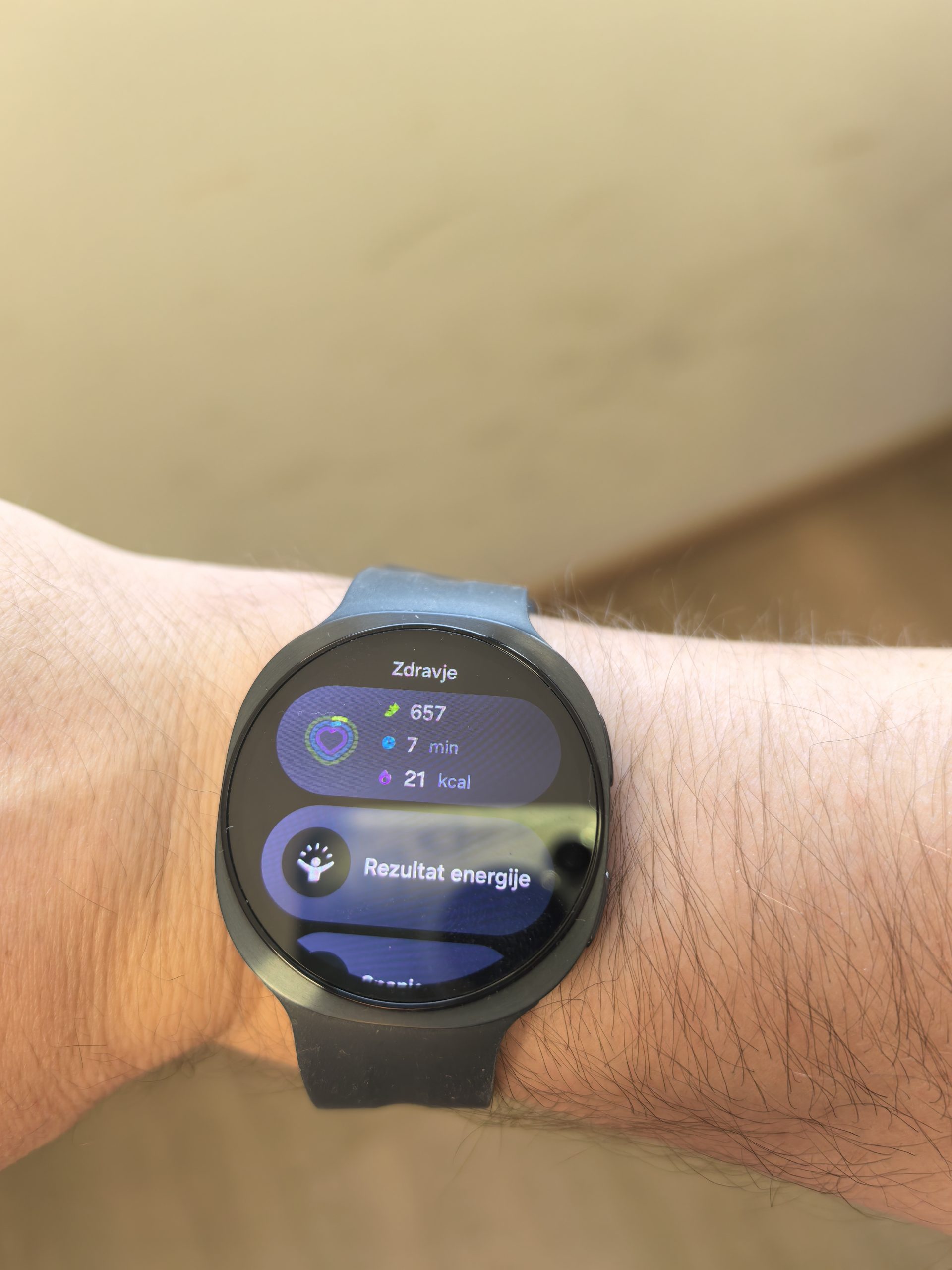
ECG, blood pressure and a whole bunch of indices
On paper, the Watch9 doesn't skimp on health, even though it's a "basic" model without the Ultra label. I didn't expect Samsung to skimp on a watch that costs over €400.
There is still a BioActive sensor on the wrist, which allows for a single-channel ECG. You just place the finger of your other wrist on the crown for ten seconds, and the Samsung Health Monitor app tells you whether it is sinus rhythm or perhaps atrial fibrillation. The function is intended for people over 22 years of age and is explicitly not a substitute for a medical examination, which Samsung also makes clear with each measurement. In addition, the watch constantly monitors for irregular heart rhythms in the background and warns you if it detects a suspicious pattern.
New is bioelectrical impedance analysis (BIA), which gives you an estimate of your body fat, muscle mass, and water content in a matter of seconds (again, by touching the crown with your finger). The measurement is quick and easy, but like all similar sensors on a watch, I take it with a grain of salt, as it's more about tracking a trend over time than a precise absolute number.
The Watch9 combines all of this (VO2Max, BIA, heart rate, steps, and activity) into a Fitness Index that provides a clear summary of your fitness, similar to the Heart Health Score, which takes into account sleep, body mass index, and exercise intensity. The watch also monitors your blood oxygen saturation overnight and alerts you to signs of moderate to severe obstructive sleep apnea. The feature requires at least two days of sleep data over a ten-day period, and is not intended for pregnant women or those with a diagnosis of sleep apnea.
The Labs section (i.e. experimental features) also includes Vascular Load, which measures vascular load during sleep, and the Antioxidant Index, which measures the level of carotenoids in the skin using a special sensor and is said to support healthy aging.
In the sports area, there is no shortage of exercise modes to choose from, including running, cycling, swimming, water aerobics, badminton, kayaking and more, although the specialized Trail Run and Diving modes are reserved exclusively for the Watch Ultra2. Also new is the Running Coach, which suggests a training plan based on your data, and warnings to protect your hearing from excessive noise in the environment.
In short, there's really nothing to criticize about Samsung's set of sensors and features. The only question is how much of this you actually use regularly and how much of it requires a Samsung phone to pair, which could be a major drawback for many who want the Watch9 as a standalone health tracker.
When it comes to sleep, Samsung has stuck at the same point.
This section was actually the most important to me, as I rarely sleep through the night in one piece with a small child. For the Galaxy Watch9, this was the category where it was the least consistent.
When I wake up at night to watch my baby, I'm often awake for anywhere from a few minutes to 45 minutes. Sometimes I sit down and soothe him, sometimes I get up and walk around the room. The Watch9 was quite unreliable in detecting these awakening episodes. Sometimes it still recorded me as asleep even though I was awake and active, other times it detected the awakening with a longer delay than it actually happened, or not at all if I was only awake for a short time and moved a little. As a result, the data on total sleep time, sleep stages, and also the calculated Energy Score and Vitals were quite unreliable. Many times the watch showed a better night than I actually had, and vice versa.
On the other hand, it was great at detecting when I was just napping and when I was actually sleeping. For example, if I took a short break in the afternoon for a 30-minute nap, it detected it with eerie accuracy. That makes it all the more strange to me that it had such problems at night. But it's true that my sample is very small. I've had the watch for a good week, and maybe the measurements would improve over time.
Battery: The Achilles heel has been dragging since the introduction
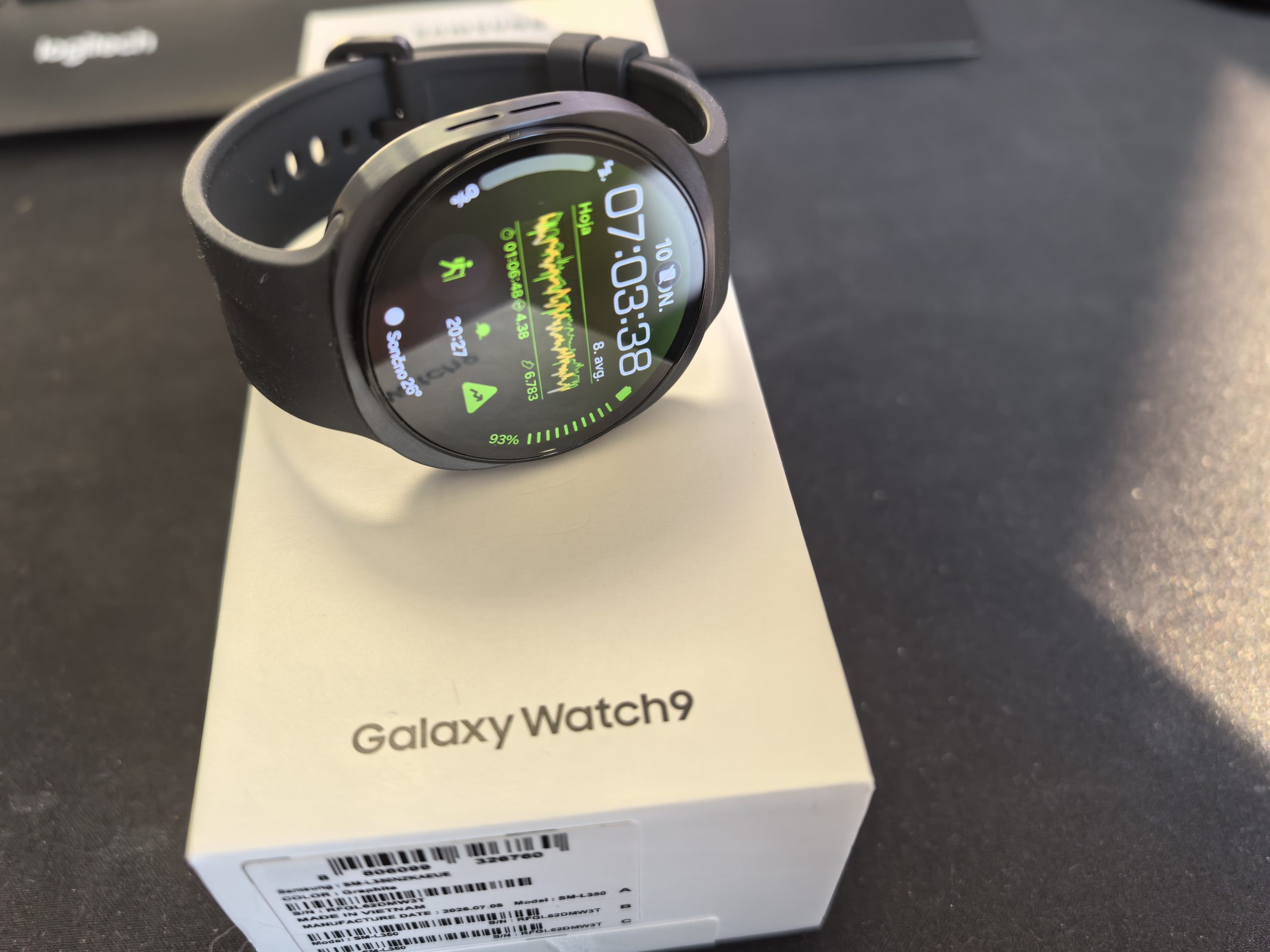
As I mentioned at the beginning, battery life is again the main pain point of this watch. Last year's 44mm Watch8 achieved up to 48 hours with normal use (auto-brightness, raise-to-wake, some walking, heart rate measurement every 15 minutes, sleep tracking at night) or half a day less if you used GPS for a long time.
The Samsung Galaxy Watch9 v barely lasted 24 hours with GPS tracking on the same settings and a daily walk (an hour and a half). The next morning I had less than 10 % left. Just tracking sleep takes about 25 % of battery.
If you replace a GPS hike with an indoor workout, you might squeeze out a day and a half to two days, emphasis on the maybe. As soon as you turn on the Always On Display, the watch falls below 24 hours of endurance after just an hour and a half of indoor exercise.
The problem, as always, is the Wear OS system. The only watch I know that has lasted longer than 2 days with this system is the OnePlus Watch 3, which lasts up to 120 hours. That's still far from other watches that don't use this system. For example, Huawei watches can last 14 days or more. The latest generation, which will be launched in September, advertises even 21 days with moderate use.
Samsung Galaxy Watch9: not much of an improvement unless you're a user of older watches
Ultimately, the Galaxy Watch9 remains a solid, but not exceptional, upgrade. I recommend it primarily to those who already have a Samsung phone and are interested in in-depth health data, accurate GPS tracking, and relatively reliable step counting even during activities with steady hands, and who are willing to charge the watch every day. However, if you are looking for a watch that will reliably and consistently record your (often fragmented) sleep, say when you have a young child, or if you simply don't like charging daily, the Watch9 did not prove to be the best choice in this test.