

Share with others:

What is RSS and why the internet still uses it

Today, we receive most of our information online passively – through social media algorithms that choose content for us. RSS reverses this process. It allows you to create your own, unfiltered news feed, where content comes to you directly from the source, ad-free.
RSS, which stands for Really Simple Syndication, is a technology that has been around for over two decades. After all these years, you would expect it to have been replaced by newer technology long ago. But that's not the case. In fact, we use it more often today than most people realize.
We still have it integrated too. In addition to the general RSS feed /rss We also have RSS feeds available for individual categories:
If anyone would like, they can take one or more of our RSS feeds at any time, integrate them into their website, and supplement their existing content.
How RSS really works
At first glance, RSS is nothing special. It's a structured file, usually in XML format, that contains a list of posts. Each post has a title, a short description, a link to the full article, and some basic metadata, such as the date or category.
But the real value of RSS is not in what it looks like, but in what it enables. Instead of the user actively visiting websites and checking for new content, RSS enables the opposite logic - the content comes to the user on its own.
This means that a website doesn't need a complicated distribution system. It just needs to publish an RSS feed, and tools, platforms, or other websites can take care of the rest.
Why RSS hasn't disappeared
Many technologies eventually disappear as they are replaced by more complex and powerful alternatives. RSS has survived precisely because it didn't try to be anything more than what it is.
Its biggest advantage is its simplicity. It doesn't require logins, doesn't require user accounts, doesn't track users, and doesn't change the rules of the game. It works the same today as it did ten years ago.
RSS also doesn't belong to any platform. It can't be locked down or restricted. Any website can use it, any developer can read it. This openness is why it's still used by many systems behind the Internet.
The third reason is automation. RSS is interesting for companies mainly because it reduces the amount of manual work. Instead of someone copying news every day, the system can do everything itself.
This is especially important for smaller teams. Many companies want to display current news on their sites, but they don't have an editorial or marketing team to prepare content on a daily basis. RSS allows them to solve this quite elegantly.

Where is RSS used today?
Although rarely noticed by users, RSS is still present in many everyday services. News aggregators like Feedly and similar applications are based on RSS feeds. Podcasts also use RSS to distribute episodes, which means that every time you subscribe to a podcast, you are actually using RSS in the background.
Many major content management systems, including WordPress, also automatically create an RSS feed for each website. This means that most websites already have RSS available, even if their owners don't realize it.
RSS also plays an important role in automation. Tools like Zapier or Make allow each new post in an RSS feed to be automatically converted into a social media post, newsletter entry, or even a database entry.
RSS as a source of fresh content
Many websites today operate statically. They have basic information about the company, contacts and a few products, and then everything stops. The problem with such sites is that they quickly feel abandoned. Fresh content creates a sense of activity. If a user sees that something is happening on the site, they have more trust in the company.
Therefore, RSS can be interesting for such companies.
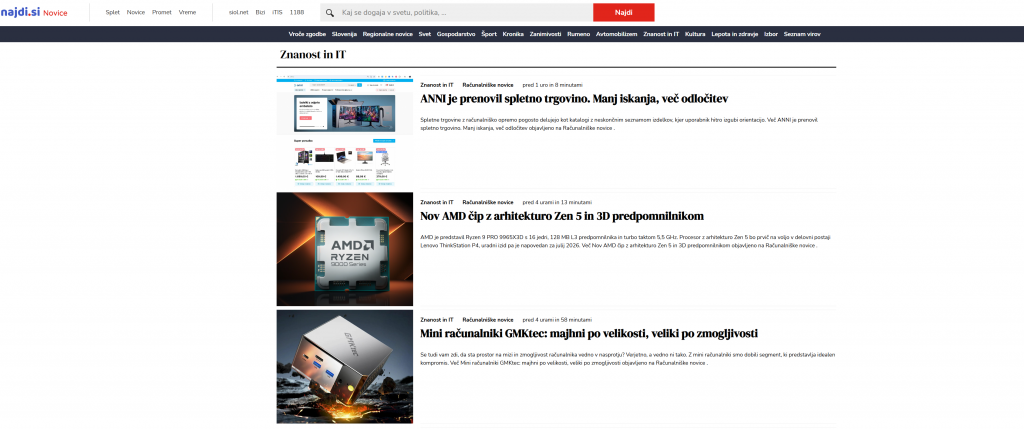
Let's say a computer retailer includes an RSS feed of Computer News on its website for reviews of the latest products:
His site can automatically display current news about the devices he sells. No writing articles. No extra work. For the visitor, this means a more interesting website. For the company, more opportunities for the user to stay on the site longer.
How to add RSS to a WordPress site
WordPress has one big advantage, RSS is already built in. Every WordPress site automatically generates an RSS feed, usually in a URL that ends with /feed/.
This means that the site owner can use RSS without any additional setup. However, if they want to include RSS as a content source on their site, the process is also quite simple. In most cases, this means using a plugin that can read RSS. Such plugins allow content from an external source to be displayed on the site as a news list or as part of a blog. The user can determine how many posts to display, whether to include images, and how often the content should be refreshed.
One of the most famous WordPress RSS plugins is Feedzy RSS FeedsIt allows you to display titles, images, summaries, post dates, and more. It also works well with modern WordPress themes and provides a pretty nice visual display.
Among the more professional solutions is WP RSS AggregatorThis plugin is especially interesting for companies and portals that want to build a larger content aggregator. It supports multiple RSS feeds at the same time, category filtering, automatic refresh, image import, and the like.
For example, a store that sells computers, phones, and gaming equipment could combine several RSS feeds of Computer News: telephony, gaming, tablets, computers... Thus, it would create its own "mini technology portal".
The result is a page that updates automatically. When a new post appears on the feed, it also appears on the page, without manual intervention. For more advanced users, there is also the option to include RSS directly in the page code or use the APIs of various platforms. However, for most cases, using a plugin is quite enough.
RSS is not modern today, but it is useful
RSS will probably never be a technology that is talked about at conferences or presented as the future of the Internet again. And honestly, it doesn't need to be. We have it so that every website, store, blog, or whatever has the ability to integrate our content. And over the years, quite a few of them have accumulated (for example find.si) who also practice this.
In the next article, we will use practical examples to show how to automate social media posts with RSS, how to use RSS for content marketing, and the like.