

Share with others:

Xpeng G9 Performance test: a real family SUV that accelerates to 100 km/h in 4.2 seconds

The Xpeng G9 Performance's hidden powerhouse surprises you, especially because you don't expect such a sporty character from such a large and comfortable car at first glance. We're used to the fact that electric drive (in combination with 4×4 drive) offers a completely different acceleration feeling than fossil fuel cars, but the way it sticks you to the seat evokes a loud "wow" - from the driver and even more so from the passengers.
While I had it on test, most people were interested in the range and power of the car. The power is sporty and you are already familiar with it, and the range is a decent 540 km for a family. To give a more accurate estimate, I would have to have it for more than 5 days, but today I could easily go on a 400-450 km trip with a charged battery.
The Chinese first shipped their Xpeng G9 to Europe about two years ago. I read online that it had some labor pains, but in the meantime, Xpeng has been rapidly developing and the result – the car I drove this time – is quite impressive.
Xpeng G9 Performance puts the European elite to a serious test
Time seems to be running differently in the Chinese car industry than elsewhere in the world, and they have offered a very competitive mix of luxury and (over)performance on four wheels. I tested the thoroughly updated Xpeng G9 in its most prestigious and powerful Performance version.


Everything is different under the skin: the technological leap to LFP chemistry
Its exterior silhouette remains elegant, aerodynamic and respectfully huge, measuring almost 4.9 meters in length. I have two parking spaces in my block of flats, and when I parked it next to the family car, it took some skill to get out if I wanted to get into both cars comfortably. Yes, the Xpeng G9 is a concrete family SUV.
But the real revolution happened where the eye can't see, that is, under the sheet metal. Xpeng took a bold step in its most expensive models and switched from NMC battery cells to more advanced LFP (lithium iron phosphate) chemistry. LFP cells have traditionally been considered more resistant and cost-effective, but less energy-dense. In a year and a half, Xpeng has made such progress in cell integration that the new battery has almost identical net capacity as before - 92.2 kWh to be exact.
Performance? Brutal!
The performance of the Performance version is simply brutal. With the combination of a permanent synchronous motor on the rear axle and an additional motor at the front, the car squeezes out a system power of 423 kW (575 hp) and offers 695 Nm of torque. When you activate the Launch Control function, this 2.4-ton electric vehicle launches from a standstill to 100 km/h in just 4.2 seconds. Acceleration is instantaneous and without loss of traction, but despite this sporty dynamics, the G9 does not pretend to be a sports car. Thanks to the top-quality standard air suspension, which can be lowered or raised from the “Normal” height by 5 cm (a total of 10 cm) and exceptional sound insulation, this is above all a top-class touring cruiser. It is much more dedicated to comfort than racing, but when you step on the pedal, it understands you and reacts instantly. In Comfort almost hovering over the potholes of our roads, in the mode Sports The chassis is noticeably firmer, the pedal is even more responsive, but it can't completely hide the laws of physics and the large mass in corners.
There is enough space everywhere.
The Xpeng G9 is not only big, it is also spacious – both in the front seats and on the back bench and behind it in the trunk. The trunk capacity is 660 liters, and with the rear seats folded down it increases to 1576 liters. Not even a station wagon would defend this, so – as far as I’m concerned – its size more than meets the needs of a family car.


Crazy charging, but find a charging station like that if you can
If the size and power of the engine somehow leave you cold, the charging speed will definitely shock you. The G9 is based on an advanced 800-volt architecture, and Xpeng proudly labels the battery with the “5C” designation. In practice, this means that the car theoretically allows charging with a power of up to an impressive 525 kW, and the official charging time from 10 to 80 % is only 12 minutes. But in Europe, such a powerful infrastructure is practically non-existent.
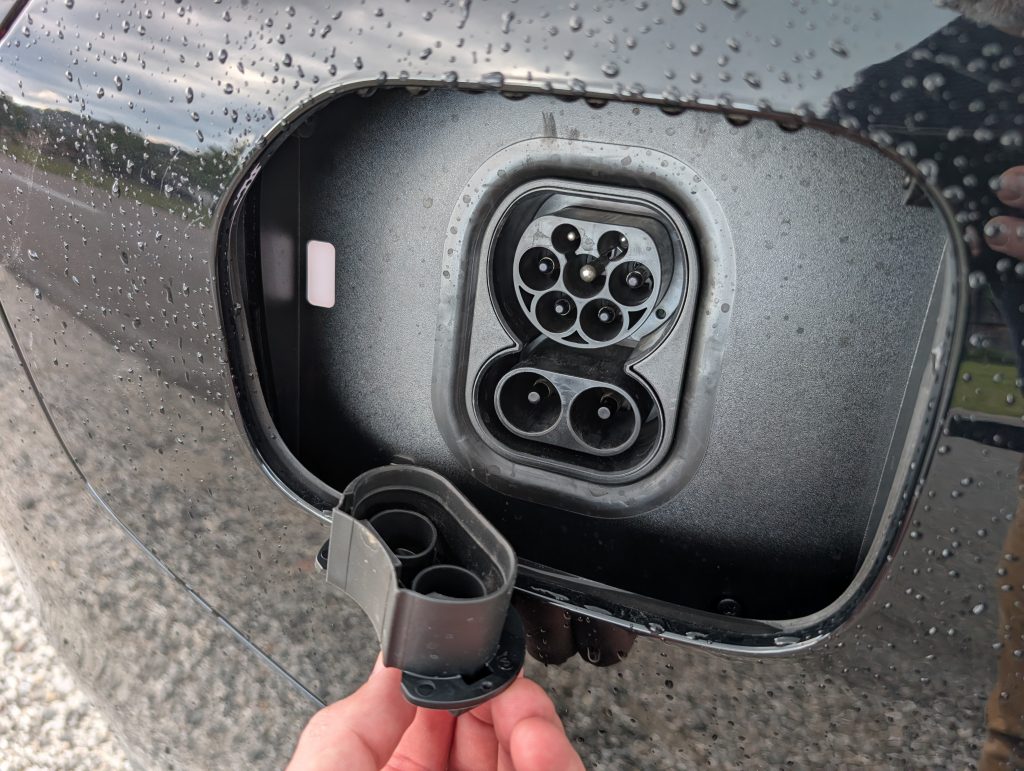
This kind of charging completely changes the strategy for long trips. However, the biggest challenge remains finding a fast charging station that is free and preferably not behind a car dealership gate that is only open during showroom hours. In a medium-sized Slovenian city, you quickly face such a challenge. On Friday evening, I lost quite a bit of time in Jesenice and in the end decided to be the first one to the gate on Saturday, which closed the way to the desired charging station in the evening.
I charged the battery from 50 % to 100 % in about an hour and the fun could begin. The day was coming when I wanted to thoroughly test the car on regional roads, mountain dirt roads and of course on the highway. And during that time, I didn't want to think about how much longer I would be able to drive.
Forgetting the issue of infrastructure, if you find a decent fast charging station, your car will be ready to continue your journey faster than you will when you stop.
Digital salon – are there too many screens or just the right amount?
It's hard to say whether you fall in love with the exterior or the interior of the Xpeng G9 more. The dashboard is characterized by three screens: a smaller 10.2-inch one in front of the driver and two massive 15-inch screens in the middle and in front of the passenger. In the middle, we control everything we need in the car - from the radio to ventilation, seats, mirrors, navigation, charging and countless other car functions. The selection menu most resembles the menu of a smartphone. On the other hand, the screen on the far right will remind you of the multimedia menu of a home TV with all possible applications. This screen has a special privacy filter built in, which means that the passenger can watch movies or browse the web while driving without disturbing the driver, who sees a dark screen.
I can praise the fact that I didn't see the multimedia screen while driving, which is really great. On the other hand, even on longer family trips in the car, we are not used to watching cartoons and I could easily miss the multimedia screen, although the kids would disagree with me after three days of driving.


However, if you add to all this Premium package, the cabin transforms into a luxurious lounge with Nappa leather seats that offer superior massage for all four passengers and ventilation even in the back seat. The Dynaudio Dolby Atmos sound system also leaves an exceptional impression, which, among other things, has a speaker built directly into the driver's headrest - so navigation instructions or phone calls reach you completely discreetly, without interrupting the music of the other passengers in the vehicle.
Assistance systems that inspire
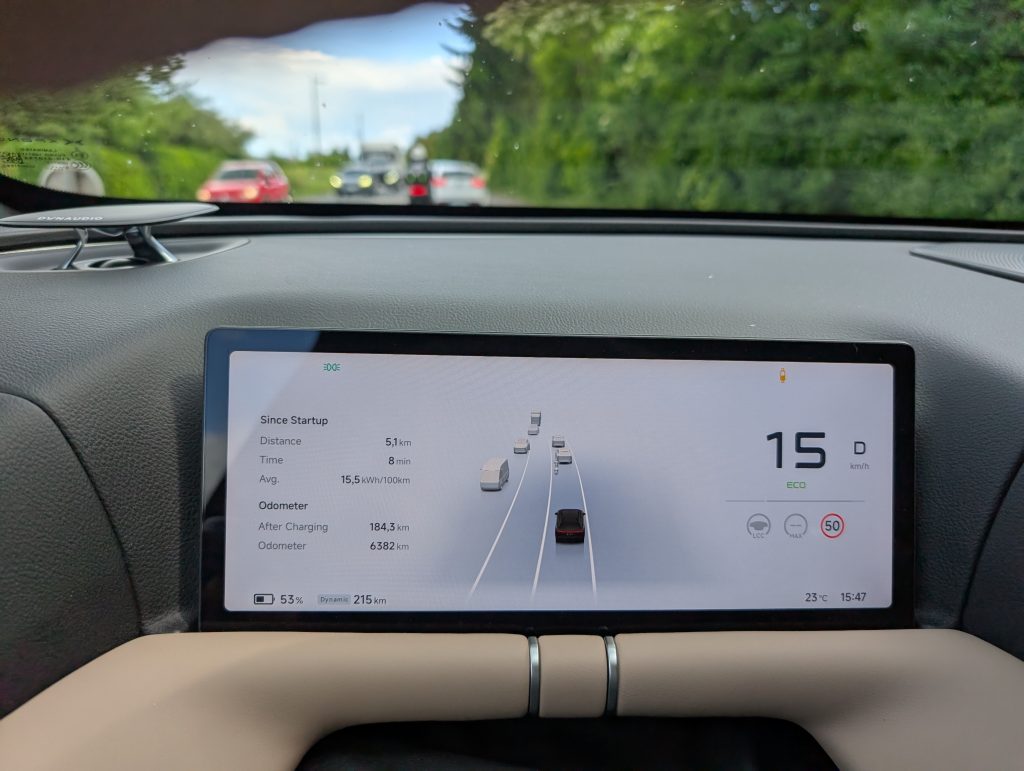
Enormous progress is also noticeable in the assistance systems, powered by the powerful Nvidia Orin-X processor. The former panic and sudden braking when suddenly joining other vehicles on the highway is a thing of the past; the system works extremely smoothly, predictably and really makes long journeys easier for the driver.
Despite the general enthusiasm, the redesign is not entirely without flaws, which are fortunately only of a software nature. I noticed that the dynamic range calculation is perhaps a little too aggressive in taking into account only the current consumption. When I was climbing a steep rural dirt road for a few kilometers towards Golica, the system calculated an unrealistically short range (160 km with a 74 % battery), on the other hand, when driving downhill (and then on the highway at a moderate speed of around 110 km/h) and the battery at 92 %, it showed me more than 600 km of range. But such extremes in driving are not very common, so I can easily forgive it. This is also a tax on the mass of this large SUV.
When you have more cameras in your car than at home
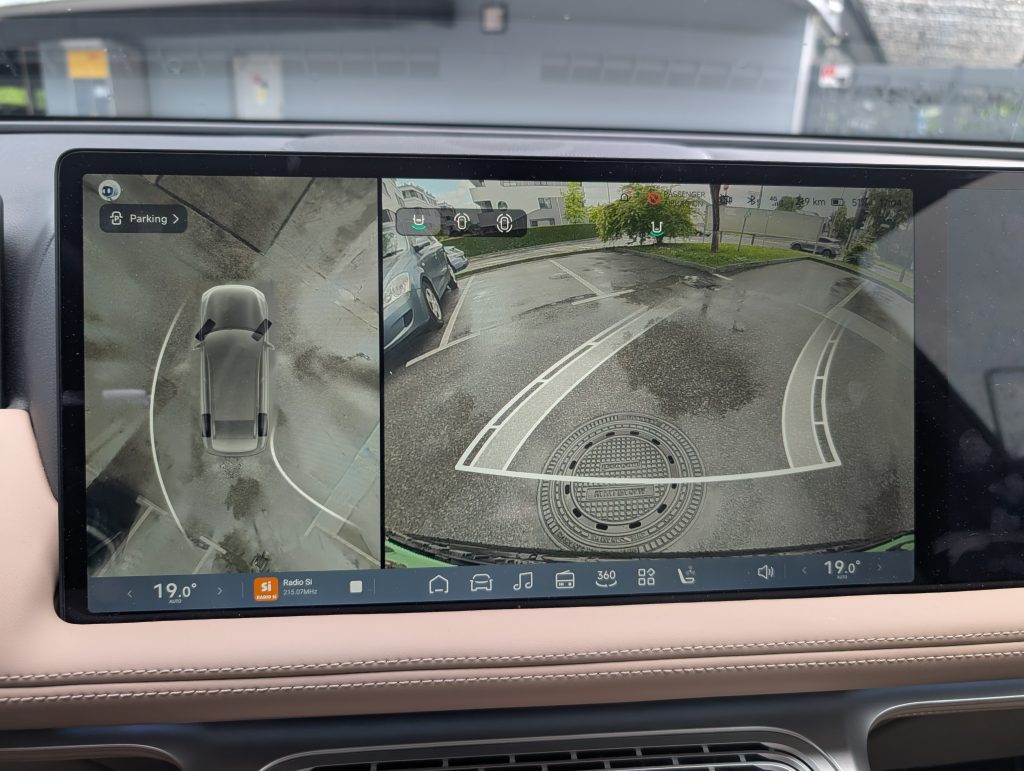
I was impressed by the parking system and the cameras. There are cameras practically all around the car, which is not so rare these days, but the image that appears on the central screen on the dashboard is really good. It also tells you exactly how many centimeters you have left to the obstacle when parking.
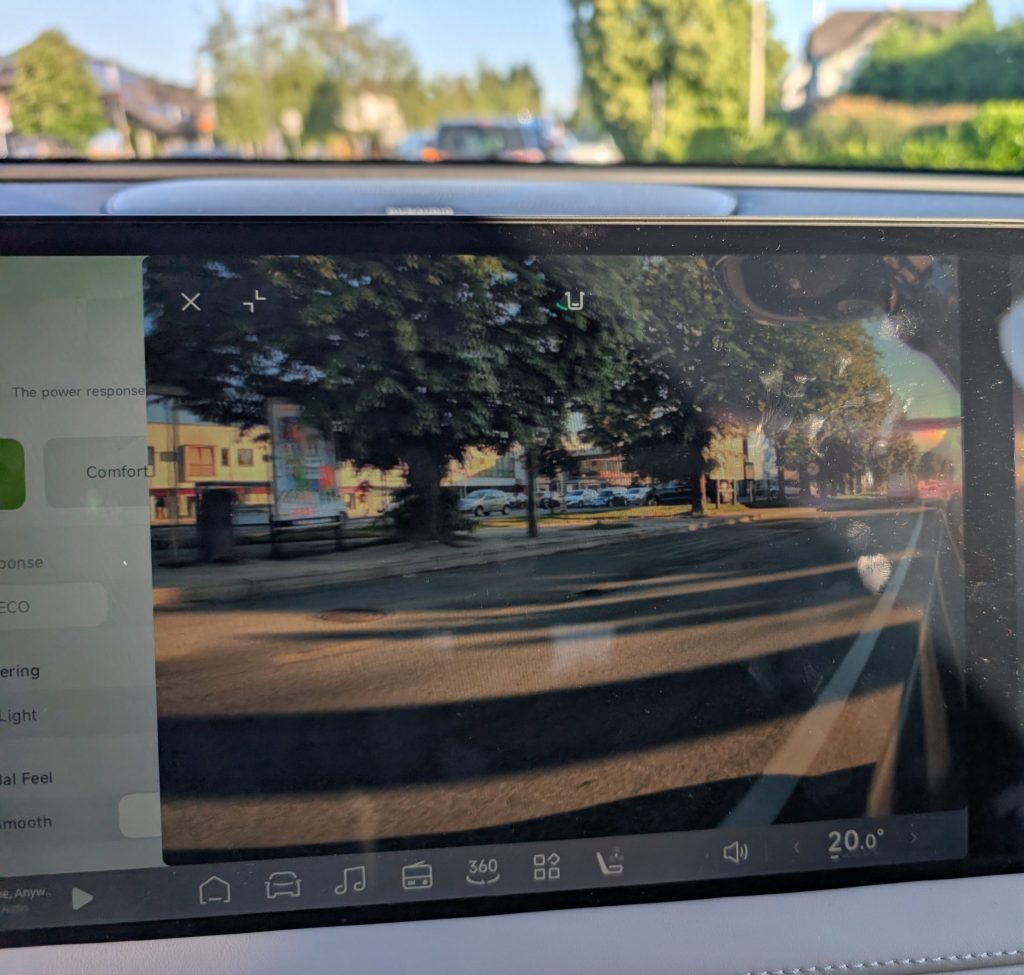
I've never had any problems with parking and the distance between the car and the car in the past, so the cameras were a great help and I expect them in a car like this, but they're not essential. I was impressed by the cameras that show the left or right blind spot when you click on the turn signal. On the highway, in addition to the warning light in the mirror, you can see the entire blind spot and the road behind you on the screen. Also, for example, cyclists and pedestrians when turning right at an intersection. From a safety point of view, I think this is great.
In this car, if you want, the driver's work is already done before parking, because the assistance system works perfectly. In the menu, you have an overview of empty parking spaces detected by the camera, you click on one, and then the Xpeng G9 does everything itself. If the parking space is too narrow or surrounded by a wall (for example, in a garage), it even folds the mirrors and tells you beforehand that it will do this.
You can talk to Xpeng G9
Just like your car tells you to fold the mirrors, you can also give it many tasks. The system is top-notch, but it's not perfect. You say: "Hey, Xpeng" and get its attention. Then, with commands in English, you can switch between driving modes, open the car window, turn on the massage, move the seat, also the mirrors, change the color of the ambient lighting ... sometimes it's easier and much faster to tell it something than to find it in the menu.
At times, we all looked at each other in the car and wondered what he was doing with his voice command, but on the other hand, there were some things that seemed quite similar to the ones he had done that he didn't understand. Then he would ask you if you could say it in another way, but even that doesn't always help.
The system also detects where the person “commanding” it is sitting. So if a child in the back asks to open the door window, it will only open theirs. At the same time, the voice assistant rejects commands from passengers that could directly affect the driver and safety – for example, moving the driver’s seat, changing the driving style, and the like.
An adventure with unlocking and locking
When it was almost time to return the car, I drove it around for a bit more. Among other things, I went to school to pick up my child. We put our bags in the trunk, including my work bag, and closed the trunk... the keys were in the bag and in the car - locked. The curse of keys, which you don't have to hand over to unlock and start the car and just have them with you. But at the same time, technology was my savior. With the help of the app (customers have the right to a digital key right away, I didn't have one at that moment), they granted me access, the app detected the key and I was able to unlock the car using Bluetooth or NFC technology, so in the case of NFC, I held my phone to the B pillar, where the tag is located. And the car miraculously unlocked.
In the app, you can also see the car's fuel consumption, charging status, set the temperature in the cabin, check the tire pressure, see how long the car has been parked, unlock/lock it, shake it, etc.


For 80,000 euros you get an incredible package
With a price tag of under 80,000 euros with all the top-of-the-line equipment, air suspension, and a towing capacity of up to 1.5 tons, the Xpeng G9 Performance represents an exceptional package.
The Chinese manufacturer is proving that it no longer competes solely on price alone, but with brutal technological superiority in the field of battery management. Traditional premium brands have serious reason to worry. If Xpeng has managed to improve its product so dramatically and eliminate almost all critical points in just a year and a half, we rightly wonder where their technology will be in two years.
The Xpeng G9 test vehicle was provided by AutoWallis. The test is not sponsored content and everything written is based on our independent testing.