

Share with others:

It's official now. Nvidia is entering the laptop and desktop market

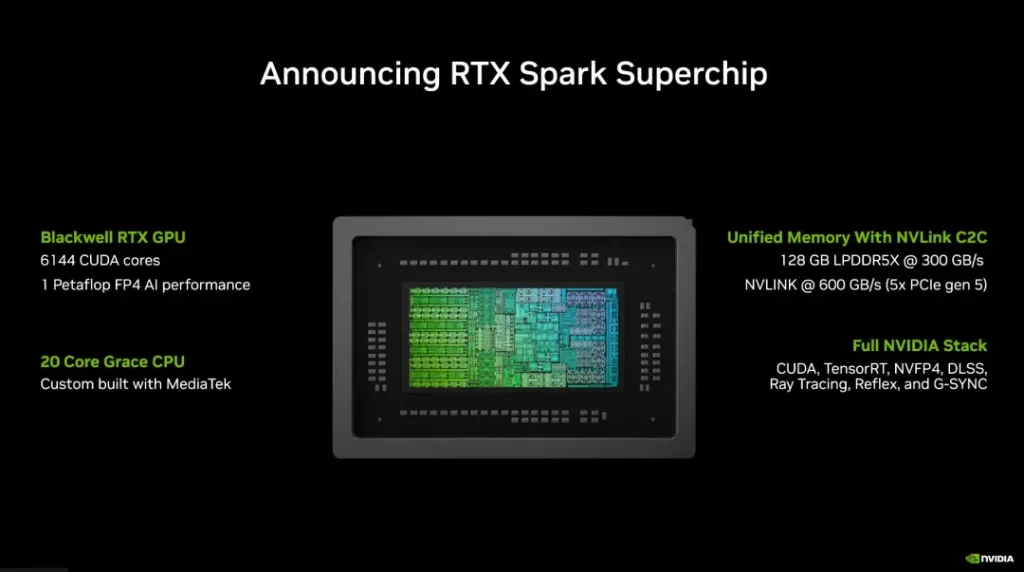
Nvidia is preparing for one of the biggest moves in its history. The company, known to most users primarily for its graphics cards and artificial intelligence chips, will officially enter the world of full-fledged consumer computer chips this fall. Intel, AMD, Apple, Qualcomm and the rest will soon have a very strong rival. They will stir the pot with the new RTX Spark chip, which is not just a source of graphics power, but is essentially a completely new computer platform.
The RTX Spark is the first chip in a new family of products that the company claims will match or even exceed the performance of the most powerful thin and light Windows PCs. Nvidia describes it as an extremely efficient personal computing chip, although it has not yet revealed specific measurements, graphs or comparisons that would support these claims numerically.
The RTX Spark is fundamentally very similar to the GB10 chip we know from the DGX Spark system, a small “personal UI supercomputer” that Nvidia introduced last year. This time, however, it is no longer a single product, but a wider family of chips. The most powerful version is said to have 20 processor cores, 6144 graphics cores and 128 GB of unified LPDDR5X memory. More affordable versions are expected to follow later, including versions with 16 GB of memory.
Transition to Arm architecture
Like Apple and Qualcomm's chips, the RTX Spark will be based on the Arm architecture. This means that older Windows software developed for Intel and AMD's x86 processors will have to run through an emulation layer. This approach can mean lower performance in some cases, but Microsoft has been improving Windows on Arm and its Prism emulation system for years. Nvidia, however, believes that its graphics and UI technology can take that experience to the next level.
The company claims that the RTX Spark will be able to process 90GB 3D scenes, edit 12K video, or play the graphically demanding game Indiana Jones and the Great Circle at 100 frames per second in 1440p. All of this is said to be possible in a laptop that is 14 millimeters thick, even without a power adapter connected.
Local artificial intelligence as a core advantage
One of the key advantages of the new platform is said to be the large amount of unified memory. With up to 128 GB of memory, RTX Spark laptops and desktop minicomputers could run UI agents with up to 120 billion parameters locally. This is an area of particular interest to Microsoft. At the Build conference, it is expected to introduce new security and isolation mechanisms for Windows that, together with Nvidia's OpenShell environment, would enable secure local operation of personal agents under user control.
Nvidia is even talking about a new computing model in which the user experience is designed around artificial intelligence. Instead of having to navigate complicated menus and interfaces for individual applications, the user would simply tell the computer what they want.
The examples the company cites range from content creators to designers and programmers. An esports streamer could tell a computer to automatically turn off the lights, mute the microphone, and change the broadcast mode during a break. A designer could create an image from a sketch, then a 3D model, and then a UI video. A software developer could have an agent that monitors a project on GitHub, detects bugs, and autonomously performs repetitive tasks.
More privacy and less cloud dependency
Nvidia emphasizes that local AI processing means greater data privacy and less reliance on cloud services and paid tokens to use large models. However, the big question remains whether the company has actually built a computer that will act as the personal digital assistant of the future, or whether this is an ambitious vision that will take a few more generations of development.
First confirmed laptops
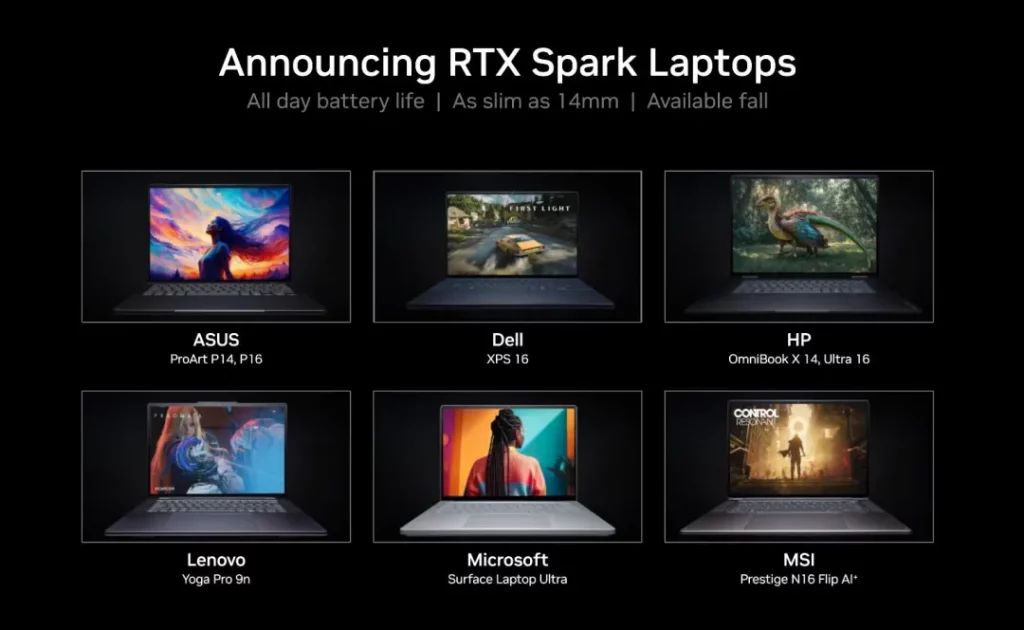
There's no shortage of partners. Among the first confirmed devices are the Asus ProArt P14 and P16, Dell XPS 16, HP OmniBook X14 and Ultra 16, Lenovo Yoga Pro 9N, Microsoft Surface Laptop Ultra, and MSI Prestige N16 Flip AI. Microsoft is said to be building RTX Spark into the new Surface Laptop Ultra, which the company describes as the most powerful Surface yet.
But that's just the beginning. Nvidia says that partners are already developing more than 30 laptops and more than 10 desktops. Among the participating companies are Acer, Asus, Dell, Gigabyte, HP, MSI and Lenovo. The RTX Spark family is expected to cover several price ranges, although the first models will clearly be aimed primarily at the premium segment.
Software support is also an important part of the story. Nvidia says that programs such as Blender, DaVinci Resolve, Maxon Cinema4D, Maxon Redshift, Topaz Photo, CapCut, Cubase, Bitwig Studio, and Affinity by Canva already run natively on Arm. Adobe is said to have prepared special optimizations for Premiere and Photoshop tailored to the new chip.


Games are coming to Windows on Arm too
There is also an interesting shift in gaming. Microsoft reportedly announced that Riot Games is bringing League of Legends and Valorant to Windows on Arm, Krafton is preparing PUBG, and Nvidia is working with developers using Easy Anti-Cheat, BattlEye, and Denuvo. This is important, as anti-cheat protection is often one of the biggest barriers to gaming on alternative environments (Arm, Linux, etc.).
Pricing and battery remain unknown
Despite all the announcements, many unknowns remain. Nvidia and Microsoft have not revealed the prices of the first computers. There are also no clear figures regarding performance or battery autonomy. Nvidia claims that the battery will be significantly better than in previous RTX laptops, but at the same time they admit that the chip's consumption can go up to 80 W. This means that even a larger battery could last a much shorter time under maximum load.
Comparisons with Intel, AMD, Apple, and Qualcomm are also unclear. Nvidia is not providing direct graphs or test results for now. It only emphasizes that the graphics part should reach approximately the level of a mobile RTX 5070 graphics card in certain applications (which is a very ambitious claim), and the processor part should be competitive with the most powerful solutions in the Windows world.
RTX Spark could be a watershed moment for the PC market, much like Apple's move to its own M1 chips. But the difference is that Nvidia is mostly just making promises for now. If they prove to be true, Windows laptops could be the beginning of a whole new category of devices: thin, powerful, locally UI-focused computers with powerful graphics and lots of unified memory. If not, RTX Spark will remain an interesting experiment.