

Share with others:

From a used phone to a functional robot

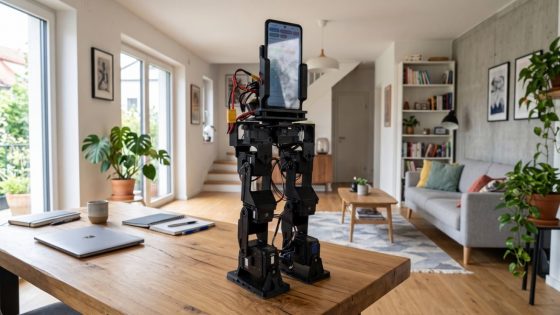
The development of small research humanoid robots traditionally requires expensive equipment such as dedicated computer vision computers, specialized sensors, and complex cabling. PhoneBot It overcomes these obstacles by taking full advantage of the components that modern smartphones already contain. The camera provides visual perception of the surroundings, the built-in IMU acts as an inner ear to maintain balance, the processor drives neural networks to control movement, and the touchscreen displays system status and controls.
The robot is 48.3 centimeters tall and weighs 1.8 kilograms with the phone and battery. It is powered by 13 inexpensive servo motors, six of which are built into each leg, and one that allows the robot to rotate its torso. This additional motor allows the robot to follow a person with a camera without having to turn its entire body. Learning to walk and pick itself up after a fall was initially done in a virtual environment using reinforcement learning, with the researchers taking into account the actual physical limitations of the motors.
The system was successfully tested on four Android devices, including an older Honor 9 from 2017, and several basic smartphones priced between €45 and €71. Since the robot has no arms and is currently adapted mainly to move on flat surfaces, it remains an experimental research platform for now. In addition, speech processing is not yet completely local to the phone, as the system currently requires a nearby laptop.
Nevertheless, the open-source project is generating a lot of interest, as the manufacturing cost is estimated at around 357 euros without the phone. This is significantly less than comparable research robots, which typically cost between 3,120 and 12,300 euros.