

Share with others:

New rules for online purchases from China (AliExpress, Shein, Temu...)

When three euros are not just three euros
For many years, online shopping from China was based on a simple equation: the product was cheap, shipping was often free, and the risk was low enough that the buyer didn't think about the purchase for too long. A phone case for a few euros, a cable, a T-shirt, a watch, a cosmetic item, a toy or a kitchen accessory were purchases where the line between need and curiosity was very blurred. Platforms like AliExpress, Shein and Temu made this a global model. The buyer didn't feel like they were importing goods from a third country, but rather that they were just ordering from an app.
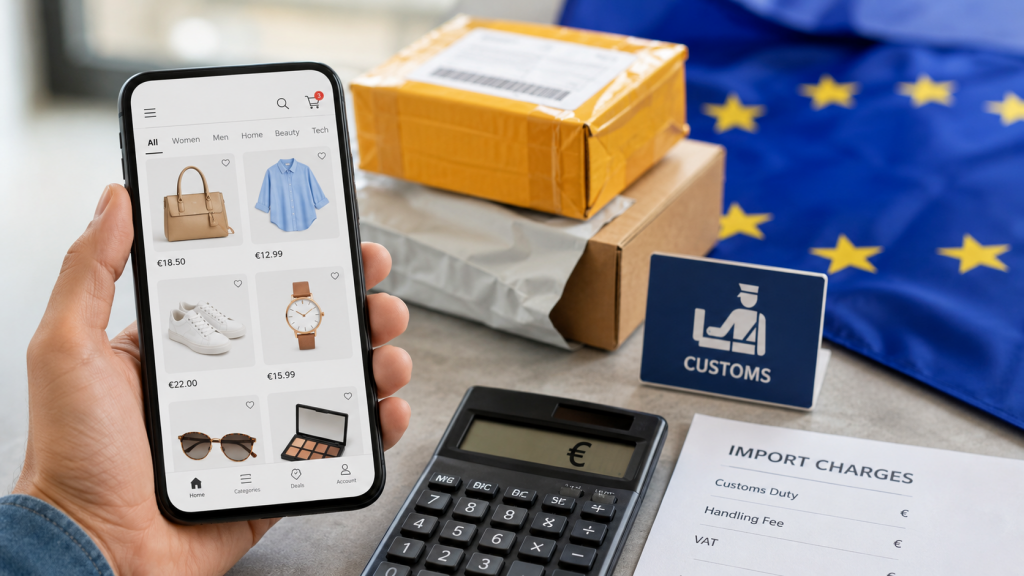
Online shopping will change again from 1 July 2026. The European Union is introducing a new temporary arrangement for small consignments from third countries up to a value of €150, which will be subject to a fixed customs duty of €3. The EU Council presented the measure as part of a wider customs reform for e-commerce, with the temporary solution to be used before the establishment of a new European customs data hub, which is envisaged as part of a wider reform of the customs system.
At first glance, three euros doesn't sound dramatic. But even for the cheapest products, such an addition can change the entire logic of the purchase. If a customer orders a product for €2.99, the additional customs duty is higher than the product itself. If they order several different products, however, the amount is not necessarily limited to a one-time three euros.
A rule that is easily misunderstood by customers
The biggest pitfall of the new regulation is that customs duty will not necessarily be charged once per package. According to the explanations of the FURS, it will be decisive how the goods are classified in the customs declaration. If there are three identical or similar products in the shipment that fall under the same customs heading, the amount can be three euros. However, if the same shipment contains, for example, a toy and a computer cable that fall under different customs headings, two items of three euros each can be charged, for a total of six euros.
The buyer will need to ask themselves whether they are buying one type of product or a mix of different products, whether the platform will send the order in one package or in several separate shipments, and whether the cost will be visible at checkout or only later.
One order is not necessarily one shipment
One of the biggest ambiguities with large platforms is logistics. A buyer can place one order in the app and pay one total amount, and the platform sends the products from different warehouses, from different sellers, or in several separate packages. FURS explained that each shipment is treated separately, which means that one payment in an online store does not necessarily mean one customs procedure.
This raises a practical issue that is often beyond the buyer's control. If the platform breaks an order into multiple packages, costs and procedures can occur multiple times. This is particularly sensitive for low-value purchases, as the additional amounts can quickly outweigh the savings that made the purchase worthwhile in the first place.
The previous appeal of Temu, Shein and AliExpress was also based on the fact that the user ordered without much understanding of customs logistics. After the introduction of the new rules, the final price in the cart does not necessarily equal the final price after customs clearance.
Why is the EU introducing changes at all?
The European Union does not interpret the measure as just a tax or customs issue. There is a much broader problem behind it: the explosion of low-value packages from third countries, especially China, and complaints about unfair competition, product safety, undervalued values and the environmental impact of mass shipments.
Reuters reported that 4.6 billion low-value shipments arrived in the EU in 2024, a figure that doubled from the previous year. The measure specifically targets cheap imports via platforms such as Shein, Temu, AliExpress and Amazon Haul.
The EU wants to end a long-standing exemption from customs duties for shipments under €150. This threshold has been increasingly controversial in digital commerce, as platforms and sellers have exploited it in a model of mass-shipping cheap products directly to consumers.
The current regulation was also problematic for European traders because they had to meet European requirements regarding safety, compliance, packaging, taxes and returns, while sellers from third countries often offered significantly lower prices and less transparent accountability.
Customs, VAT and any additional costs
It is important to stress that the new tariff does not mean the abolition of VAT. VAT is already often charged at the point of purchase for online purchases from third countries, especially when the platform uses the IOSS system. The new levy is an additional layer of cost related to the customs processing of shipments. The EU Council highlighted in the agreement that the fixed duty will apply to goods for which sellers outside the EU are registered in the IOSS system for VAT purposes, which according to the Council covers a large share of e-commerce flows in the EU.
The question remains whether the buyer will see the new customs fee in the online shopping cart. FURS explains that customs will generally be calculated with the customs declaration, or whether the platform will already charge the consumer it will depend on the business model of the individual platform. This means that one platform may display the cost at the time of purchase, while another may leave it to a later stage of shipment processing.
What does this mean for AliExpress, Shein and Temu?
Platforms will have to change their pricing, logistics, or both. The most user-friendly scenario would be for the platform to display all costs at checkout. The buyer would then immediately see the real price and decide whether the purchase is worth it. A less transparent scenario is for part of the costs to be displayed only at import, delivery, or pickup.
It will also be important for platforms to consider whether they will try to stock more goods within the EU. If a product has already been imported, cleared through customs and sold from a European warehouse, the user experience is different than with a direct shipment from a third country.


Will this really stop cheap packages?
Most likely not. The new rules will make shopping more expensive and less impulsive, but they will not erase Temu, Shein or AliExpress from the habits of European shoppers. The prices of many products will still be lower than those of European providers, even after additional costs. But the difference will be smaller, especially for small, low-value products.
Some Chinese merchants are already trying to avoid additional costs and complications by using different logistics. One common route is shipping via other European countries, such as Hungary, where the package first enters the EU and then reaches the Slovenian buyer as an internal shipment within the European market.
Such models will become even more important under the new rules, as platforms look for ways to maintain the feeling of a fast and cheap purchase for the customer. Shipping through Hungary, Poland, the Netherlands or other logistics hubs can mean that goods are first imported into the EU in large quantities and then distributed to individual customers. This can work legally, as long as duties are paid upon import and the documentation is in order.
The end of cheap baskets?
The new rules do not mean the end of online purchases from China. At the same time, the new regulation will not automatically solve all the problems that caused it. Chinese platforms are extremely flexible, and logistics routes through European warehouses and countries like Hungary suggest that some of the pressure will quickly shift to finding new bypasses.
The real test of the reform will therefore not be whether the customer pays three euros more for the cable. The test will be whether the European system can establish fair rules for everyone: for the consumer, who has the right to a clear final price; for the European trader, who cannot compete with unregulated imports; and for online platforms, who will have to take more responsibility for the products they send to the European market.